
The Origins of Advanta-STAR / Withan Lemmon

Around 1990, I was working as the inventory and sales training manager at a brand-new Dodge dealership. I was responsible for ordering the inventory—Ram 150s, Shadows, lots of Caravans, the usual stuff for a Dodge store at the time.
Then one day a car carrier pulled in. I don't know how they got them all on there, but it was carrying 12 Dodge Omnis. I remember looking through my orders and thinking, Did I order any Dodge Omnis?
I hadn't.
While the driver was unloading them, another car carrier pulled in. Twelve more Dodge Omnis. I went out and asked the driver how many of these things he was leaving. I figured maybe one or two belonged to us.
Nope.
The whole truck was ours.
So was the other one.
Twenty-four 1990 Dodge Omnis—the last ones ever built. And they were a problem. I got on the phone with the Chrysler Zone office and started yelling. My boss got on the phone with his boss and started yelling at him, too—in Cajun French.
Finally, I told our Zone guy, Al Stevens, something along the lines of, "Al, what are you doing? This is a two-year supply of Dodge Omnis."
"No," he said. "We figured it's more like three."
And he hung up on me.
That was comforting.
Part of my pay was tied to inventory, time on lot and floorplan expense, so I had a very personal interest in figuring out what we were going to do with 24 cars that Chrysler itself had apparently calculated would take us over three years to sell.
Making matters worse, we'd poached much of our sales staff from Toyota, Honda and Nissan dealerships, where they'd been selling newer, more polished products.
The Omni made its debut for the 1978 model year and had never been redesigned. In fact, 1990 brought its first real refresh, and even that was pretty modest: different side mirrors, a driver's airbag and a new dashboard design.
Underneath, it was still basically a car that had been introduced twelve model years earlier. And it looked it. Our salespeople knew it, too. They weren't exactly enthusiastic about having two dozen of them dropped in their laps.
I knew the Omni a little better than they did. I'd sold them myself, and I'd owned a Shelby GLHS—the hot-rod Omni that Carroll Shelby built in Whittier, California. That car had given me a healthy respect for what the basic Omni platform was capable of.
The ordinary Omni wasn't a GLHS, of course. But I knew it wasn't necessarily a bad little car. Our problem was that we had way too many of them, they looked old, and neither our salespeople nor our customers had much reason to think highly of them.
So I decided that if we were going to sell these things, we needed to know everything we possibly could about them.
Remember, this was around 1990. There was no Google. No ChatGPT. No manufacturer website where I could download a comparison chart.
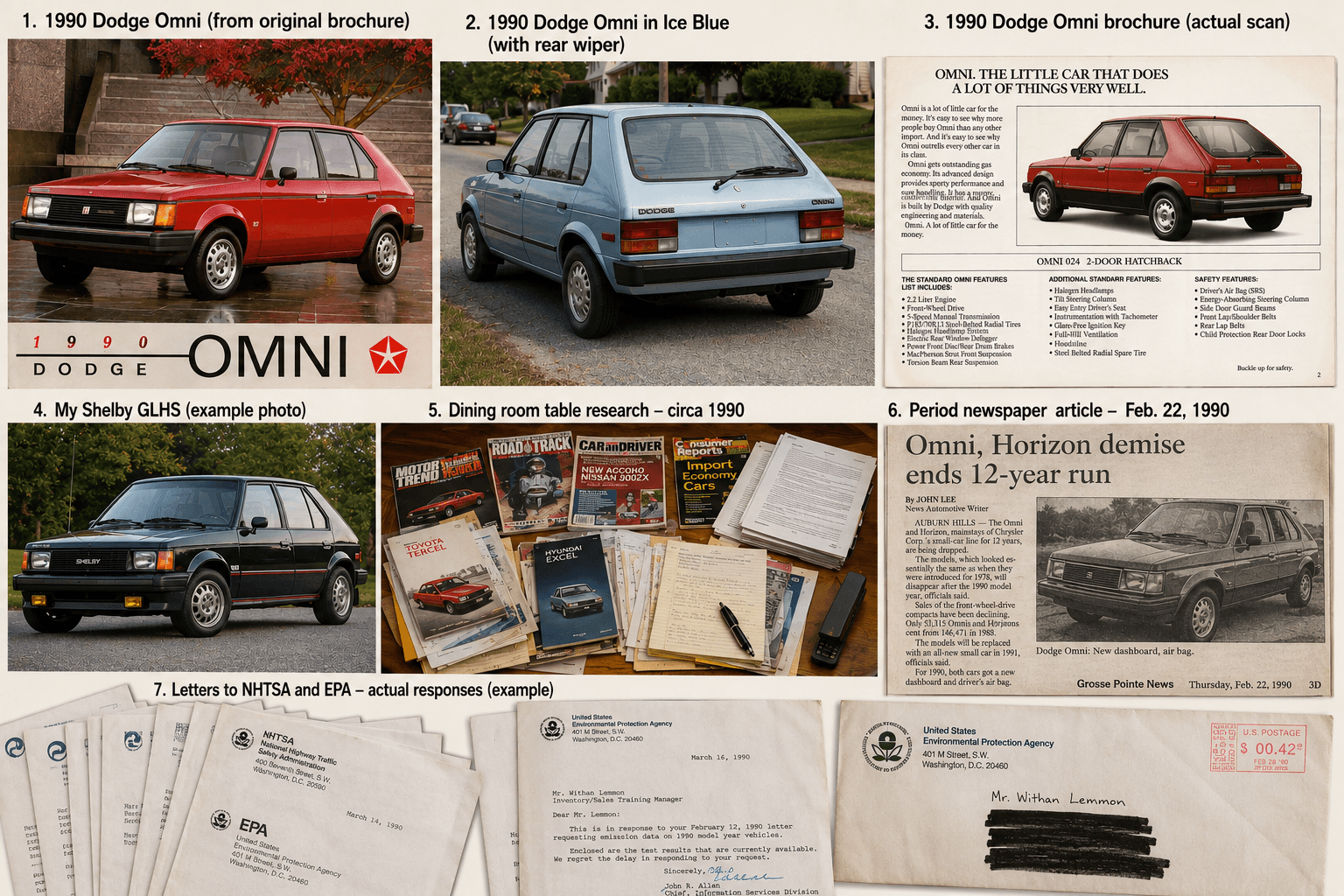
Research meant something entirely different then. My dining-room table disappeared under stacks of Car and Driver, Motor Trend, Road & Track, Consumer Reports and whatever other car and consumer magazines I could get my hands on.
I wrote actual letters to NHTSA and the EPA asking for government test results and information. Then I waited for it to come back through the mail. I drove around town stopping at Toyota, Hyundai and other dealerships collecting brochures on the cars we'd be competing against.
Piece by piece, I started putting together the picture.
I researched the Omni against cars like the Toyota Tercel, Ford Escort, Chevrolet Cavalier, Nissan Sentra, and Hyundai Excel. I gathered specifications, acceleration and braking information, government crash-test results and whatever else I could find. But I wasn't just collecting specifications.
I started writing out the benefit of each meaningful difference I found—why that difference could actually matter to somebody buying the car. Eventually I had something like 48 pages of research: crash tests, stopping distances, acceleration, specifications, competitive differences—the whole bit.
Forty-eight pages explaining why, among the cheap little economy cars you could buy at the time, the Dodge Omni was actually a pretty damn good one. I printed it, copied it, stapled the pages together and gave a copy to every salesperson.
They promptly threw them in the bottoms of their desk drawers and forgot about them.
At first.
Remember something else about 1990: there wasn't a smartphone in their pocket to scroll through when the showroom was dead. Eventually they got bored enough to pull those pages back out.
They'd read a little bit. Put it down. Pick it up another day. Talk about something they'd found
with another salesperson. I doubt most of them could have passed a test on the facts in those 48 pages.
That wasn't what mattered. They started becoming impressed by the little car.
Even when they couldn't remember the particular fact that had convinced them, they retained the impression that the Omni was a whole lot better than it looked—and a whole lot better than its reputation suggested. The cars hadn't changed. The salespeople had.
And the biggest change was enthusiasm.
Before, an Omni could be the car you showed somebody almost apologetically: Well, if you can't afford that, I guess I can show you one of these. Now they'd walk somebody out to one enthusiastically.
This is a great little car. You're going to love this thing.
They'd point things out. They'd talk positively about it. They'd actually sell the car instead of acting like management was forcing them to dispose of it. The more they learned about the Omni and its competitors, the more confidence—and enthusiasm—they had when somebody walked onto the lot. That alone was a revelation to me. But then those 48 pages started finding their way into the deals themselves.
If there was a hiccup somewhere in the sale—especially if the customer was considering one of the competing cars—the salesperson would start digging through the junk in his desk until he
found that increasingly crumpled 48-page packet. Then he'd hand the whole thing to the customer.
"Here. Read this." And then leave.
No 48-page presentation. No salesperson standing there reciting specifications. No attempt to talk the customer into agreeing with what was on the pages. He'd shut up and let the customer read it.
Then he'd head for the tower.
"I've got them on that third light-blue Omni, the one with the rear wiper. I gave them Lemmon's comparison stuff. They're sitting there reading it. Help me out." The sales manager or a closer would take it from there. By then, those pages had been doing the talking. That turned out to be remarkably effective.
We sold all 24 Omnis before any of them had a birthday on the lot.
I had put the last two into DRAC—our dealership rental fleet. Then I pulled them out, had them pinstriped and put them on the showroom floor. We made a profit even on those last two, without even counting the DRAC allowance or paydown.
Twenty-four cars that Chrysler itself figured represented over three years worth of inventory.
Gone before the first one turned a year old.
I learned something from those cars that I've never forgotten: Product knowledge doesn't just give a salesperson more information. It changes the salesperson's confidence and enthusiasm for the product.
And customers can tell the difference. That experience eventually became Advanta-STAR Automotive Research. We've spent the last 35-plus years taking that original idea considerably further—researching vehicles from hundreds of sources, examining vehicles ourselves, identifying meaningful competitive differences and translating features into benefits and selling advantages. The tools have certainly changed.
Today we can get all the information with a little less gas and shoe leather, and no more digging through a dining-room table covered in magazines, writing letters to government agencies and waiting for the mailman.
But having access to information isn't the same thing as knowing what information matters. That's true today with AI just as it was in 1990 with a stack of magazines. And we’re still talking about dozens and dozens of sources. Finding information is the easy part.
Knowing what to look for, determining whether it's accurate, understanding why a difference matters and turning that knowledge into something useful to a salesperson and a customer—that's the hard part.
Today our research can be delivered through a phone, a tablet, a computer, or an API instead of a 48-page stack of stapled paper. But the principle hasn't changed.
Know your product.
Know the competition.
Understand the difference.
And be able to explain why that difference should matter to the person buying the car. All these years later, I guess I owe those 24 Dodge Omnis a thank-you.